
Friday, 13 December 2013

Wednesday, 2 October 2013
Holy Guardian Angels

"For he hath given his angels charge over thee; to keep thee in all thy ways.” - Psalm 90: 11
"No evil shall befall you, nor shall affliction come near your tent, for to His Angels God has given command about you, that they guard you in all your ways. Upon their hands they will bear you up, lest you dash your foot against a stone" - Psalm 91: 10-12
The Catechism of the Catholic Church states: “From infancy to death human life is surrounded by their watchful care and intercession”(No. 336). St Basil asserted: “Beside each believer stands an angel protector and shepherd leading him to life. ”
The truth that each and every human soul has a Guardian Angel who protects us from spiritual and physical evil has also been shown throughout the Old Testament, and is made very clear in the New Testament.
It is written that the Lord Jesus is strengthened by an angel in the Garden of Gethsemane and that an angel delivered St Peter from prison in the Acts of the Apostles.
But Jesus makes the existence and function of guardian angels explicit when He says: "See that you despise not one of these little ones: for I say to you, that their angels in heaven always see the face of my Father who is in heaven." (Matthew 18: 10).
In saying this, Jesus points out that all people, even little children, have a guardian angel and that the angels are in Heaven, always looking at the face of God throughout their mission on earth, which is to guide us and protect us throughout our pilgrimage to the house of our Father. As St Paul says: "Are they not all ministering spirits, sent to minister for them, who shall receive the inheritance of salvation?"(Hebrews 1: 14)
However, they guide us to Heaven only if we desire it. St Thomas Aquinas wrote that angels cannot act directly upon our will or intellect, although they can do so on our senses and imaginations – thus encouraging us to make the right decisions. In Heaven our guardian angels, though no longer needing to guide us to salvation, will continue to enlighten us.
It is important to pray to your guardian angel and become friends with your angel. Ask for your guardian angel's help when you're stuck in traffic, when you need a parking place, and when you need help with your computer or the Internet. Call upon them in times of temptation or weakness and they will assist, enlighten, and protect you.
The prayer to the guardian angels has been present in the Church since at least the beginning of the 12th century.
Guardian Angel Prayer:
Angel of God, my Guardian dear, to whom God's love commits me here, ever this day be at my side, to light and guard, to rule and guide. Amen.
Guardian Angel Quotes:
"The servants of Christ are protected by invisible, rather than visible, beings. But if these guard you, they do so because they have been summoned by your prayer. "
~ St Ambrose
“Let us affectionately love His angels as counselors and defenders appointed by the Father and placed over us. They are faithful; they are prudent; they are powerful; Let us only follow them, let us remain close to them, and in the protection of the God of heaven let us abide.”
~ St Bernard of Clairvaux
"God's universal providence works through secondary causes . . . The world of pure spirits stretches between the Divine Nature and the world of human beings; because Divine Wisdom has ordained that the higher should look after the lower, Angels execute the Divine plan for human salvation: they are our Guardians, who free us when hindered and help to bring us home."
~ St Thomas Aquinas

Tuesday, 1 October 2013
St Thérèse of the Child Jesus

St Thérèse of the Child Jesus and the Holy Face was buried in the Lisieux municipal cemetery on 4 October 1897. She was the first to be buried in the new plot her monastery had purchased in response to the city's new legislative directives prohibiting interment inside the cloister. In view of what took place after St Thérèse's death, it can now be said that the new directives were providential, since they enabled hundreds of thousands of pilgrims to visit her grave over a period of twenty-five years. Had St Thérèse been buried inside the cloister, this would never have been possible. Only in 1923 on the occasion of her beatification were her mortal remains transferred to the Carmelite chapel where they are kept to this day.

When people stand in the presence of the mortal remains of St Thérèse of Lisieux, or have some contact with her relics, as with petals from an unpetalled rose, God, who received through her humanity so many signs of love, is pleased in turn to manifest his love through her bodily remains.

From these poor signs, God's salvific power reveals and unfolds itself. It is enough to read the many volumes recounting favours and cures obtained through contact with St Thérèse's relics, as well as the abundant correspondence that arrives daily in Lisieux.

We are indeed blessed at the Holy Grail retreat to be able to display numerous first class relics of St Thérèse at a dedicated shrine created for the purpose of veneration. Alongside her holy relics are those of beloved St Francis and St Clare of Assisi.
.
Monday, 15 October 2012
St Teresa of Avila
.

St Teresa of Avila’s scent emanated throughout the whole monastery the moment she died. Saint Thérèse de Lisieux (known as “the Little Flower”) was said to have produced a strong scent of roses at her death, which was detectable for days afterward. Likewise, Padre Pio’s stigmata is said to have emanated the smell of roses.


Born to the Spanish nobility, the daughter of Don Alonso Sanchez de Cepeda and Doña Beatriz, Teresa grew up reading the lives of the saints, and playing at “hermit” in the garden. Crippled by disease in her youth, which led to her being well educated at home, she was cured after prayer to St Joseph. Her mother died when Teresa was 12, and she prayed to Our Lady to be her replacement. Her father opposed her entry to religious life, so she left home without telling anyone, and entered a Carmelite house at 17. Seeing her conviction to her call, her father and family consented.
Soon after taking her vows, Teresa became gravely ill, and her condition was aggravated by the inadequate medical help she received; she never fully recovered her health. She began receiving visions, and was examined by Dominicans and Jesuits, including Saint Francis Borgia, who pronounced the visions to be holy and true.
She considered her original house too lax in its rule, so she founded a reformed convent of Saint John of Avila. Teresa founded several houses, often against fierce opposition from local authorities. Mystical writer. Proclaimed a Doctor of the Church on 27 September 1970 by Pope Paul VI.
There are more than one type of stigmata. Some affected people display no outward signs of the stigmata at all. These are referred to as the invisible stigmata. Other stigmatics' wounds refuse to clot or heal. They remain fresh and uninfected.
In very rare cases the blood is said to have a perfumed odour, known as the Odour of Sanctity. The Odour of Sanctity can also be present separate from stigmata. Saint Teresa of Avila was reported to have emitted heavenly scents after she died.
Those who have shown the wounds of Christ are often ecstatics. Upon receiving the stigmata they receive a mystical vision of Christ. While the have been extremely rare cases on non-Catholic stigmatics most are devout Catholics.
The first mentioned stigmatic is St Francis of Assisi in whom the stigmata were of a character never seen subsequently. Since that time over five hundered stigmatics have been accepted by the Roman Catholic Church. The first record of a female stigmatic is the Blessed Christina von Stommeln circa 1310.
St Teresa of Avila’s scent emanated throughout the whole monastery the moment she died. Saint Thérèse de Lisieux (known as “the Little Flower”) was said to have produced a strong scent of roses at her death, which was detectable for days afterward. Likewise, Padre Pio’s stigmata is said to have emanated the smell of roses.

http://pathofreconciliation.blogspot.co.uk/2010/10/st-teresa-of-avila.html
http://www.marypages.com/TeresaofAvila.htm
http://www.marypages.com/TeresaofAvila.htm
.
Thursday, 4 October 2012
St Francis of Assisi
.


It was on the feast of St Francis of Assisi twenty-one years ago that I was elevated to the episcopate. I wrote of a mystical experience I had during the consecration itself in The Grail Church, page 101:


"The tranquil features of the emdieval saint appeared mementarily, like a pale image against the rich vestments of the consecrating prelate, but as the vision intensified it transformed from a representation of Cimabue's famous painting of the friar to that of Our Lord. ... St Francis, more than anyone, interprets Christ's challenge to all aspiring disciples with a freshness and a vitality. Christ, the only way to God, is our Master and gentle Francis is a fellow-disciple guiding us along the often difficult path all Christians must follow. The little saint suffered silently and painfully for the Church of the Middle Ages with its abuses, thinking he could change the proud prelates with their clerical pomp not by criticism but by holy humility and reverence. Undoubtedly some were transformed by his Christ-like example, but Franciscans have nevertheless been persecuted on occasions ..."

Founder of the Franciscan Order, born at Assisi in Umbria in 1181 or 1182 — the exact year is uncertain — St Francis died there on 3 October 1226. His feast is held on October 4th. Many of the stories that surround his life deal with his love for animals. One day, while Francis was travelling with some companions, they happened upon a place in the road where birds filled the trees on either side. Francis told his companions to "wait for me while I go to preach to my sisters the birds." The birds surrounded him, intrigued by the power of his voice, and not one of them flew away.

St Francis preached the teaching of the Catholic Church, that the world was created good and beautiful by God but suffers a need for redemption because of the primordial sin of man. He preached to man and beast the universal ability and duty of all creatures to praise God, and the duty of men to protect and enjoy nature as both the stewards of God's creation and as creatures ourselves.

Saint Francis' Canticle of All Creatures
Most High, all-powerful, all-good Lord,
All praise is Yours, all glory, all honour and all blessings.
To you alone, Most High, do they belong,
and no mortal lips are worthy to pronounce Your Name.
Praised be You my Lord with all Your creatures,
especially Sir Brother Sun,
Who is the day through whom You give us light.
And he is beautiful and radiant with great splendour,
Of You Most High, he bears the likeness.
Praised be You, my Lord, through Sister Moon and the stars,
In the heavens you have made them bright, precious and fair.
Praised be You, my Lord, through Brothers Wind and Air,
And fair and stormy, all weather's moods,
by which You cherish all that You have made.
Praised be You my Lord through Sister Water,
So useful, humble, precious and pure.
Praised be You my Lord through Brother Fire,
through whom You light the night
and he is beautiful and playful and robust and strong.
Praised be You my Lord through our Sister,
Mother Earth who sustains and governs us,
producing varied fruits with coloured flowers and herbs.
Praise be You my Lord through those who grant pardon
for love of You and bear sickness and trial.
Blessed are those who endure in peace,
By You Most High, they will be crowned.
Praised be You, my Lord through Sister Death,
from whom no-one living can escape.
Woe to those who die in mortal sin!
Blessed are they She finds doing Your Will.
No second death can do them harm.
Praise and bless my Lord and give Him thanks,
And serve Him with great humility.
.
Tuesday, 2 October 2012
Holy Guardian Angels
.

A Guardian Angel is a spiritual being assigned to protect and guide particular persons or groups. Belief in Guardian Angels can be traced throughout antiquity. The concept of tutelary angels was extensively developed in the middle ages, and is part of the Church’s devotional beliefs. It is a colourful and popular expression of our underlying belief in a personal Providence taught by Jesus: “The very hairs of your head are all numbered. So don’t be afraid; you are worth more than many sparrows” (Matthew 10: 30-31) and “If God so clothes the grass that is today in the field, and tomorrow is cast into the oven; how much more you, O ye of little faith?” (Luke 6: 28).
In Genesis 18-19, angels carry out God’s wrath against the cities of the plain, and deliver Lot from danger; in Exodus 32:34, God says to Moses: “My angel shall go before you.” Later we have the story of Tobias, which enshrines the words of Psalm 91: 11: “He has given his angels charge over you; to keep you in all your ways.” (Cf. Psalm 33: 8 and 34: 5) In Daniel 10 angels are entrusted with the care of particular districts; one is called “prince of the kingdom of the Persians.” and Michael is termed “one of the chief princes”; cf. Deuteronomy 32: 8 (LXX); and Ecclesiasticus 17: 17 (LXX).
In late Judaism the belief developed that the people have a heavenly representative, a Guardian Angel. The belief that angels can be guides and intercessors for human beings is implied in Job 33: 23-6, and in the Book of Daniel (10: 13) where the “prince of the Persian kingdom” contends with Gabriel. The same verse mentions “Michael, one of the chief princes,” and Michael is one of the few angels named in the Bible. In the New Testament Book of Jude, Michael is described as an Archangel. The Book of Enoch, part of the Ethiopian Church’s canon of scripture, says that God will “set a guard of holy angels over all the righteous” (1 Enoch 100:5) to guard them during the end of time, while the wicked are being destroyed.
In Rabbinic Literature, the Rabbis expressed the notion that there are indeed guardian angels appointed by Yahweh to watch over people. Rashi on Daniel 10: 7 “Although a person does not see something of which he is terrified, his Guardian Angel in heaven does see it; and so he becomes terrified.” Modern rabbis clarify that people may indeed have guardian angels. God watches over people and the Guardian Angels are emissaries to aid in this task. Thus, while not prayed to directly, they are part of how our prayer and response come about.
In the New Testament belief in Guardian Angels seems to have greater precision. Angels are envoys between God and man; and Christ set a seal upon the Old Testament teaching: “See that you despise not one of these little ones: for I say to you, that their angels in heaven always see the face of my Father who is in heaven.” (Matthew 18: 10). A twofold aspect of the doctrine is seen here: even little children have Guardian Angels, and these same angels do not lose the vision of God by the fact that they have a mission to fulfil on earth. The idea that people are protected by Guardian Angels is perhaps also implied in Hebrews 1: 14, “Are they not all ministering spirits, sent forth to minister for them who shall be heirs of salvation?”
Acts 12: 12-15 suggests that a specific angel is assigned to protect each individual. After Peter had been escorted out of prison by an angel, he went to the home of Mary the mother of John Mark. When the servant girl ran to tell the group that Peter was there, they thought it must be his angel. Since then, Peter’s Guardian Angel is the most commonly depicted in art, most famously Raphael’s fresco (in the Vatican) of the Deliverance of Saint Peter from prison. Another key example is the angel who comforted Christ in the garden.
Whether Guardian Angels attend every individual is not consistently upheld by the Church Fathers, and is not an “article of faith,” although the concept is clear in both the Old and New Testaments. According to St. Jerome the concept is in the “mind of the Church” and he stated that: “how great the dignity of the soul, since each one has from his birth an angel commissioned to guard it.”
The belief in and theology about angels has undergone many refinements since antiquity. Belief in both the East and the West is that Guardian Angels serve to protect whichever person God assigns them to, and pray to God on that person’s behalf. The first Christian theologian to offer a detailed doctrine about Guardian Angels appears to have been Honorius of Autun (1080-1154), who said that every soul was assigned a Guardian Angel the moment it was put into a body. Scholastic theologians augmented the theory of Angelic Guardians. Thomas Aquinas agreed with Honorius and held that the lowest order of angels served as guardians, and his view was most successful in popular thought, but Duns Scotus said that any angel might accept the mission.
This feast, like many others, was local before it was placed in the Roman calendar. It was not in the breviary of Pius V, published in 1568; but there was a request from Cordova in 1579 for permission to have a feast in honour of the Guardian Angels. In the 17th century Clement X (1670-1676 ) made the Feast of Guardian Angels an obligatory feast for the whole Latin Church to be celebrated on October 2nd. This gives the sanction of papal authority to an ancient and cherished belief. The multiplicity of feasts is in fact quite a modern development, and that the Guardian Angels were not honoured with a special feast in the early Church is no evidence that they were not prayed to and reverenced. Pope John Paul II urged belief in Guardian Angels in conjunction with devotion to our Blessed Lady: “Let us invoke the Queen of angels and saints, that she may grant us, supported by our Guardian Angels, to be authentic witnesses to the Lord’s paschal mystery.”
.
Monday, 1 October 2012
St Thérèse of the Infant Jesus and the Holy Face
.

The Catholic church celebrates the feast of St Thérèse of the Infant Jesus and the Holy Face, also known as "the Little Flower" on October 1st of every year. She died on September 30th and traditionally the saint's feast day if held on the following day.
The spread of devotion to St Thérèse of Lisieux is one of the impressive religious manifestations of our time. During her few years on earth this young French Carmelite was scarcely to be distinguished from many another devoted nun, but her death brought an almost immediate awareness of her unique gifts. Through her letters, the word-of-mouth tradition originating with her fellow-nuns, and especially through the publication of Histoire d'un ame, St Thérèse of the Child Jesus or "The Little Flower" soon came to mean a great deal to innumerable people; she had shown them the way of perfection in the small things of every day. Miracles and graces were being attributed to her intercession, and within twenty-eight years after death, this simple young nun had been canonised. In 1936 a basilica in her honor at Lisieux was opened and blessed by Cardinal Pacelli; and it was he who, in 1944, as Pope Pius XII, declared her the secondary patroness of France. "The Little Flower" was an admirer of St Teresa of Avila, and a comparison at once suggests itself. Both were christened Teresa, both were Carmelites, and both left interesting autobiographies. Many temperamental and intellectual differences separate them, in addition to the differences of period and of nationality; but there are striking similarities. They both patiently endured severe physical sufferings; both had a capacity for intense religious experience; both led lives made radiant by the love of Christ. In her autobiography, St Thérèse writes that her personality changed after her mother's death, and from being childishly merry she became withdrawn and shy. While St Thérèse was indeed developing into a serious-minded girl, it does not appear that she became markedly sad. We have many evidences of liveliness and fun, and the oral tradition, as well as the many letters, reveal an outgoing nature, able to articulate the warmest expressions of love for her family, teachers, and friends.
While many saints are celebrated with prayer and special rituals or festivals, a St Thérèse festival appears to be celebrated primarily by simple prayer, spiritual service and kindness to others. "The little way" is her signature, meaning the simple love from the heart and acceptance in communion with God are the most fervent. The rose is her symbol.

Shortly before her death she said: "After my death I will let fall a shower of roses. I will spend my Heaven doing good on earth." Many miracles in her name are accompanied by the presence of or the scent of roses.

It is the twentieth anniversary of my mother's death tomorrow, and St Thérèse of Liseux was in my mother's thoughts and bore a very large influence on her in later years.

St Teresa of Avila had been more influential to my mother in her early life, but in the last three decades it was St Thérèse of Liseux who took precedence.

When I saw my mother (pictured above) in death in the little gothic chapel set in a garden isolated from the funeral director’s office, to place items of devotion in her coffin, I was struck on each occasion when I visted how she remained so completely without any trace of corruption. There was something almost saintly about her as she lay motionless in her coffin, fresh and absent of death’s all too familiar hand. It was difficult to believe she had really gone as I returned in the evenings to lift the lid and view her, but what struck me most was the fragrance of roses.
There were no roses in the small chapel which housed just my mother's coffin. Yet their presence was apparent. Then I remembered how the scent of roses accompanied miracles in the name of St Thérèse.
Like her favourite saints, my mother remained somehow fragrant in death, resisting decomposition until the last, even when I replaced the lid on her coffin in the stone chapel for the last time.

She became the “first person I would anoint and on whose behalf I would recite the prayers for the newly dead, since receiving the mitre.” [The Grail Church, page 102.]

My mother’s funeral was also the first I would conduct in my office as bishop. Sadly, it would not be my last where family and friends are concerned. The funeral was held at Islington and St Pancras Cemetery on the feast day of St Teresa of Avila.

O Father in Heaven, Who through St Thérèse of the Child Jesus of the Holy Face, dost desire to remind the world of the Merciful Love that fills Thy Heart, and the childlike trust we should have in Thee, humbly we thank Thee for having crowned with so great glory Thine ever faithful child, and for giving her wondrous power to bring unto Thee, day by day, innumerable souls who will praise Thee eternally.
St Thérèse of the Child Jesus of the Holy Face, remember thy promise to do good upon earth, shower down thy roses on those who invoke thee and obtain for us from God the graces we hope for from His infinite goodness.

God our Father, You have promised your Kingdom to those who are willing to become like little children. Help us to follow the way of Saint Thérèse with confidence so that by her prayers we may come to know your eternal glory. Through Christ our Lord. Amen.
.
.
Friday, 6 January 2012
Epiphany
.

.
O God
Who by a star
guided the wise men to the worship of your Son
we pray you to lead to yourself
the wise and great of every land
that unto you every knee may bow,
and every thought be brought into captivity
Through Jesus Christ our Lord.
.
Sunday, 1 January 2012


Sunday, 25 December 2011
Christmas
.

At the altar, Jesus, Who was born into the world to communicate divine Life to us, feeds us with His Body and Blood, His Soul and His Divinity, conforming our wills to His and vivifying us with His Love, that we may live as "Other Christs."


Today the Church celebrates the Birth of the Word of God according to the flesh. In relatively recent times the three Masses on Christmas have symbolised respectively Christ's human birth from a Virgin, His spiritual birth in our souls and His eternal birth from the Father. This Feast may have been instituted at this date to replace a pagan feast which honoured the Sun.
Saint Francis of Assisi was the first to erect a representation of the stable and manger in which Christ was born. This very beautiful custom is followed in most parish churches and is beloved by Catholics and other Christians alike. Visits to such mangers help to make vivid the Nativity scene, but we should remember that the altar actually is our Lord's birthplace and manger-throne.
At the altar, Jesus, Who was born into the world to communicate divine Life to us, feeds us with His Body and Blood, His Soul and His Divinity, conforming our wills to His and vivifying us with His Love, that we may live as "Other Christs."
May the Infant Saviour be born in your heart today. Merry Christmas!


.
Saturday, 15 October 2011
Ecstasy of St Teresa
.

The Ecstasy of Saint Teresa — alternatively Saint Teresa in Ecstasy or Transverberation of Saint Teresa(L'Estasi di Santa Teresa or Santa Teresa in estasi) — is the central sculptural group in white marble set in an elevated aedicule in the Cornaro Chapel, Santa Maria della Vittoria, Rome. It was designed and completed by Gian Lorenzo Bernini, the leading sculptor of his day, who also designed the setting of the Chapel in marble, stucco and paint. It is generally considered to be one of the sculptural masterpieces of the High Roman Baroque.

Bronze replica of the statue installed at Holy Grail Retreat.
The two central sculptural figures of the swooning nun and the angel with the spear derive from an episode described by Teresa of Avila, a mystical cloistered Discalced Carmelite reformer and nun, in her autobiography, ‘The Life of Teresa of Jesus’ (1515–1582). Her experience of religious ecstasy in her encounter with the angel is described as follows:
"I saw in his hand a long spear of gold, and at the iron's point there seemed to be a little fire. He appeared to me to be thrusting it at times into my heart, and to pierce my very entrails; when he drew it out, he seemed to draw them out also, and to leave me all on fire with a great love of God. The pain was so great, that it made me moan; and yet so surpassing was the sweetness of this excessive pain, that I could not wish to be rid of it. The soul is satisfied now with nothing less than God. The pain is not bodily, but spiritual; though the body has its share in it. It is a caressing of love so sweet which now takes place between the soul and God, that I pray God of His goodness to make him experience it who may think that I am lying." — St Teresa of Avila (Chapter XXIX; Part 17, autobiography)
The group is illuminated by natural light which filters through a hidden window in the dome of the surrounding aedicule, and underscored by gilded stucco rays. Teresa is shown lying on a cloud indicating that this is intended to be a divine apparition we are witnessing. Other witnesses appear on the side walls; life-size high-relief donor portraits of male members of the Cornaro family are present and shown discussing the event in boxes as if at the theatre. Although the figures are executed in white marble, the aedicule, wall panels and theatre boxes are made from colored marbles. Above, the vault of the Chapel is frescoed with an illusionistic cherub-filled sky with the descending light of the Holy Ghost allegorized as a dove.

The art historian Rudolf Wittkower has written:
"In spite of the pictorial character of the design as a whole, Bernini differentiated between various degrees of reality, the members of the Cornaro Chapel seem to be alive like ourselves. They belong to our space and our world. The supernatural event of Teresa’s vision is raised to a sphere of its own, removed from that of the beholder mainly by virtue of the isolating canopy and the heavenly light."


.
Tuesday, 4 October 2011
St Francis of Assisi
.

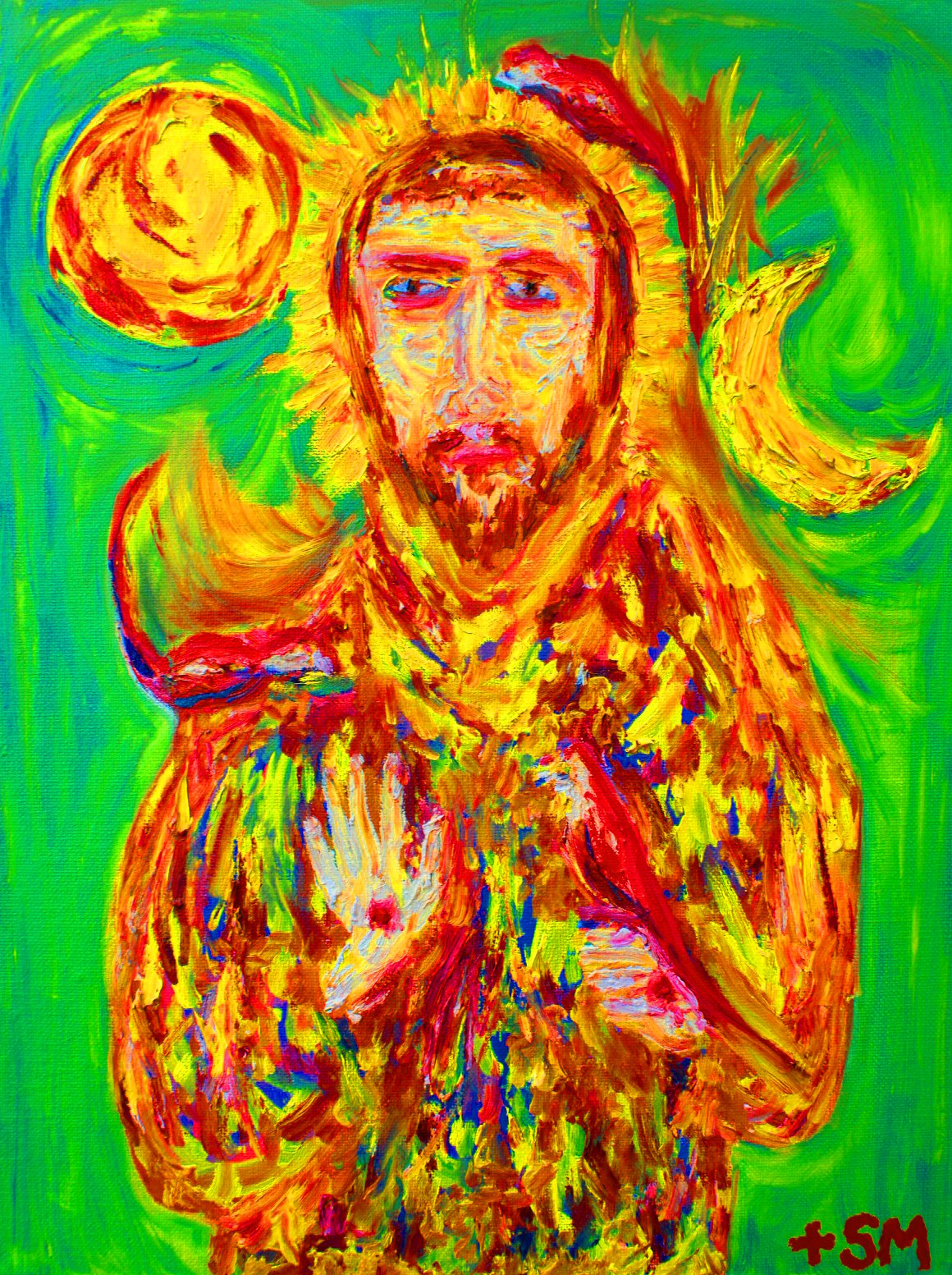
St Francis of Assisi is mine and many other people's favourite saint. It was on the feast of St Francis that I was elevated to the episcopate in 1991. Few saints have had greater impact on my life than this humble leader of an Order at first unpopular with the Church authorities until they realised he walked more closely in Our Lord's footsteps than any of them. His experience and part in supernatural events is also well chronicled, most notably his visions, levitation and stigmata.
Francis was born in 1182, the son of a wealthy cloth merchant. His early years were frivolous, but an experience of sickness and another of military service were instrumental in leading him to reflect on the purpose of life. One day, in the Church of San Damiano, he heard Christ saying to him: "Francis, repair my falling house." He took the words literally, and sold a bale of silk from his father's warehouse to pay for repairs to the church of San Damiano. His father was outraged, and there was a public confrontation at which his father disinherited and disowned him, and he in turn renounced his father's wealth. One account says that he not only handed his father his purse, but also took off his expensive clothes, laid them at his father's feet, and walked away naked. He declared himself "wedded to Lady Poverty," renounced all material possessions, and devoted himself to serving the poor. Since he could not pay for repairs to the Church of San Damiano, he undertook to repair it by himself. He moved in with the priest, and begged stones lying useless in fields, shaping them for use in repairing the church. He got his meals, not by asking for money so that he might live at the expense of others, but by scrounging crusts and discarded vegetables, and by working as a day labourer, insisting on being paid in bread, milk, eggs, or vegetables rather than in money. Soon a few companions joined him. Dante in his Paradiso has Aquinas say of him:
.
"Let me tell you of a youth whose aristocratic father disowned Him because of his love for a beautiful lady. She had been married before, to Christ, and was so faithful a spouse to Him that, while Mary only stood at the foot of the Cross, she leaped up to be with Him on the Cross. These two of whom I speak are Francis and the Lady Poverty. As they walked along together, the sight of their mutual love drew men's hearts after them. Bernard saw them and ran after them, kicking off his shoes to run faster to so great a peace. Giles and Sylvester saw them, kicked off their shoes and ran to join them ..."
.
After three years (in 1210) the Pope authorised the forming of the Order of Friars Minor, commonly known as the Franciscans.
Below is my own attempt to portray the little saint (oil on canvas) who means so much to so many.
Sunday, 2 October 2011
Holy Guardian Angels
.

My mother introduced me to St Teresa of Avila and, later on, to St Thérèse of Lisieux. Her death on the day following the feast of the latter was the most difficult moment of my life. Her last breath came at twenty minutes past five o’clock on the feast of the Holy Guardian Angels 1992. All I can remember is my father’s distant voice proclaiming: “She’s gone.” Two little words that were of themselves devastating ― yet I knew in my heart she had not gone at all, but had passed into the Lord’s safekeeping where she would be for eternity. Like her favourite saints, my mother remained as fragrant as flowers in death, resisting decomposition until the last; even when I replaced the lid on her coffin in the stone chapel for the very last time. She became the “first person I would anoint and on whose behalf I would recite the prayers for the newly dead, since receiving the mitre.” [The Grail Church, Holy Grail, 1995, page 102.] My mother’s funeral was also the first I would conduct in my episcopal office. It was held at Islington and St Pancras Cemetery on the feast day of St Teresa of Avila, one of the two saints my mother was most close to; the other being St Thérèse of Lisieux. I also conducted a funeral service in the same cemetery chapel some eight years later for my father.

"For he hath given his angels charge over thee; to keep thee in all thy ways.” - Psalm 90: 11
"No evil shall befall you, nor shall affliction come near your tent, for to His Angels God has given command about you, that they guard you in all your ways. Upon their hands they will bear you up, lest you dash your foot against a stone" - Psalm 91: 10-12
The Catechism of the Catholic Church states: “From infancy to death human life is surrounded by their watchful care and intercession” (No. 336). St Basil asserted: “Beside each believer stands an angel protector and shepherd leading him to life. ”
The truth that each and every human soul has a Guardian Angel who protects us from spiritual and physical evil has also been shown throughout the Old Testament, and is made very clear in the New Testament.
It is written that the Lord Jesus is strengthened by an angel in the Garden of Gethsemane and that an angel delivered St Peter from prison in the Acts of the Apostles.
But Jesus makes the existence and function of guardian angels explicit when He says: "See that you despise not one of these little ones: for I say to you, that their angels in heaven always see the face of my Father who is in heaven." (Matthew 18: 10).
In saying this, Jesus points out that all people, even little children, have a guardian angel and that the angels are in Heaven, always looking at the face of God throughout their mission on earth, which is to guide us and protect us throughout our pilgrimage to the house of our Father. As St Paul says: "Are they not all ministering spirits, sent to minister for them, who shall receive the inheritance of salvation?" (Hebrews 1: 14)
However, they guide us to Heaven only if we desire it. St Thomas Aquinas wrote that angels cannot act directly upon our will or intellect, although they can do so on our senses and imaginations – thus encouraging us to make the right decisions. In Heaven our guardian angels, though no longer needing to guide us to salvation, will continue to enlighten us.
It is important to pray to your guardian angel and become friends with your angel. Ask for your guardian angel's help when you're stuck in traffic, when you need a parking place, and when you need help with your computer or the Internet. Call upon them in times of temptation or weakness and they will assist, enlighten, and protect you.
The prayer to the guardian angels has been present in the Church since at least the beginning of the 12th century.
Guardian Angel Prayer:
Angel of God, my Guardian dear, to whom God's love commits me here, ever this day be at my side, to light and guard, to rule and guide. Amen.
Guardian Angel Quotes:
"The servants of Christ are protected by invisible, rather than visible, beings. But if these guard you, they do so because they have been summoned by your prayer. "
~ St Ambrose
“Let us affectionately love His angels as counselors and defenders appointed by the Father and placed over us. They are faithful; they are prudent; they are powerful; Let us only follow them, let us remain close to them, and in the protection of the God of heaven let us abide.”
~ St Bernard of Clairvaux
"God's universal providence works through secondary causes . . . The world of pure spirits stretches between the Divine Nature and the world of human beings; because Divine Wisdom has ordained that the higher should look after the lower, Angels execute the Divine plan for human salvation: they are our Guardians, who free us when hindered and help to bring us home."
~ St Thomas Aquinas

Today is the feast of the Holy Guardian Angels. Paul V was the first Pope, in 1608, to authorise a feast day in honour of guardian angels. Pope Clement X changed the date to October 2nd and Leo XIII, in 1883, upgraded the date to a double major feast. There is a proper Office in the Roman Breviary and a proper Mass in the Roman Missal, which contains all the apposite extracts from Sacred Scripture bearing on the three-fold office of the angels, to praise God, to act as His messengers, and to watch over mortal men. "Let us praise the Lord whom the Angels praise, whom the Cherubim and Seraphim proclaim Holy, Holy, Holy" (second antiphon of Lauds). "Behold I will send my angel, who shall go before thee, and keep thee in thy journey, and bring thee into the place that I have prepared. Take notice of him, and hear his voice" (Exodus 23; capitulum ad Laudes). The Gospel of the Mass includes that pointed text from St Matthew 18: 10: "See that you despise not one of these little ones: for I say to you that their angels in heaven always see the face of my Father who is in heaven." Although October 2nd has been fixed for this feast in the Roman calendar, it is kept, by papal privilege, in Germany and many other places on the first Sunday (computed ecclesiastically) of September, and is celebrated with special solemnity and generally with an octave (Nilles, II, 503). This feast, like many others, was local before it was placed in the Roman calendar. It was not one of the feasts retained in the Pian breviary, published in 1568; but among the earliest petitions from particular churches to be allowed, as a supplement to this breviary, the canonical celebration of local feasts, was a request from Cordova in 1579 for permission to have a feast in honour of the Guardian Angels. (Bäumer, Histoire du Breviaire, II, 233.) Bäumer, who makes this statement on the authority of original documents published by Dr. Schmid (in the Tübinger Quartalschrift, 1884), adds on the same authority that "Toledo sent to Rome a rich proprium and received the desired authorisation for all the Offices contained in it, Valencia also obtained the approbation in February, 1582, for special Offices of the Blood of Christ and the Guardian Angels."
My mother introduced me to St Teresa of Avila and, later on, to St Thérèse of Lisieux. Her death on the day following the feast of the latter was the most difficult moment of my life. Her last breath came at twenty minutes past five o’clock on the feast of the Holy Guardian Angels 1992. All I can remember is my father’s distant voice proclaiming: “She’s gone.” Two little words that were of themselves devastating ― yet I knew in my heart she had not gone at all, but had passed into the Lord’s safekeeping where she would be for eternity. Like her favourite saints, my mother remained as fragrant as flowers in death, resisting decomposition until the last; even when I replaced the lid on her coffin in the stone chapel for the very last time. She became the “first person I would anoint and on whose behalf I would recite the prayers for the newly dead, since receiving the mitre.” [The Grail Church, Holy Grail, 1995, page 102.] My mother’s funeral was also the first I would conduct in my episcopal office. It was held at Islington and St Pancras Cemetery on the feast day of St Teresa of Avila, one of the two saints my mother was most close to; the other being St Thérèse of Lisieux. I also conducted a funeral service in the same cemetery chapel some eight years later for my father.

"For he hath given his angels charge over thee; to keep thee in all thy ways.” - Psalm 90: 11
"No evil shall befall you, nor shall affliction come near your tent, for to His Angels God has given command about you, that they guard you in all your ways. Upon their hands they will bear you up, lest you dash your foot against a stone" - Psalm 91: 10-12
The Catechism of the Catholic Church states: “From infancy to death human life is surrounded by their watchful care and intercession” (No. 336). St Basil asserted: “Beside each believer stands an angel protector and shepherd leading him to life. ”
The truth that each and every human soul has a Guardian Angel who protects us from spiritual and physical evil has also been shown throughout the Old Testament, and is made very clear in the New Testament.
It is written that the Lord Jesus is strengthened by an angel in the Garden of Gethsemane and that an angel delivered St Peter from prison in the Acts of the Apostles.
But Jesus makes the existence and function of guardian angels explicit when He says: "See that you despise not one of these little ones: for I say to you, that their angels in heaven always see the face of my Father who is in heaven." (Matthew 18: 10).
In saying this, Jesus points out that all people, even little children, have a guardian angel and that the angels are in Heaven, always looking at the face of God throughout their mission on earth, which is to guide us and protect us throughout our pilgrimage to the house of our Father. As St Paul says: "Are they not all ministering spirits, sent to minister for them, who shall receive the inheritance of salvation?" (Hebrews 1: 14)
However, they guide us to Heaven only if we desire it. St Thomas Aquinas wrote that angels cannot act directly upon our will or intellect, although they can do so on our senses and imaginations – thus encouraging us to make the right decisions. In Heaven our guardian angels, though no longer needing to guide us to salvation, will continue to enlighten us.
It is important to pray to your guardian angel and become friends with your angel. Ask for your guardian angel's help when you're stuck in traffic, when you need a parking place, and when you need help with your computer or the Internet. Call upon them in times of temptation or weakness and they will assist, enlighten, and protect you.
The prayer to the guardian angels has been present in the Church since at least the beginning of the 12th century.
Guardian Angel Prayer:
Angel of God, my Guardian dear, to whom God's love commits me here, ever this day be at my side, to light and guard, to rule and guide. Amen.
Guardian Angel Quotes:
"The servants of Christ are protected by invisible, rather than visible, beings. But if these guard you, they do so because they have been summoned by your prayer. "
~ St Ambrose
“Let us affectionately love His angels as counselors and defenders appointed by the Father and placed over us. They are faithful; they are prudent; they are powerful; Let us only follow them, let us remain close to them, and in the protection of the God of heaven let us abide.”
~ St Bernard of Clairvaux
"God's universal providence works through secondary causes . . . The world of pure spirits stretches between the Divine Nature and the world of human beings; because Divine Wisdom has ordained that the higher should look after the lower, Angels execute the Divine plan for human salvation: they are our Guardians, who free us when hindered and help to bring us home."
~ St Thomas Aquinas
.
Thursday, 29 September 2011
St Michael the Archangel
.

Four times is the name of St Michael recorded in Scripture:
(1) Daniel 10: 13 sqq., Gabriel says to Daniel, when he asks God to permit the Jews to return to Jerusalem: "The Angel [D.V. prince] of the kingdom of the Persians resisted me . . . and, behold Michael, one of the chief princes, came to help me . . . and none is my helper in all these things, but Michael your prince."
(2) Daniel 12, the Angel speaking of the end of the world and the Antichrist says: "At that time shall Michael rise up, the great prince, who standeth for the children of thy people."
(3) In the Catholic Epistle of St Jude: "When Michael the Archangel, disputing with the devil, contended about the body of Moses" etc. St Jude alludes to an ancient Jewish tradition of a dispute between Michael and Satan over the body of Moses, an account of which is also found in the apocryphal book on the assumption of Moses (Origen, De Principiis III.2.2). St Michael concealed the tomb of Moses; Satan, however, by disclosing it, tried to seduce the Jewish people to the sin of hero-worship. St Michael also guards the body of Eve, according to the "Revelation of Moses" ("Apocryphal Gospels" etc., ed. A. Walker, Edinburgh, p. 647).
(4) Apocalypse 12: 7: "And there was a great battle in heaven, Michael and his angels fought with the dragon." St John speaks of the great conflict at the end of time, which reflects also the battle in heaven at the beginning of time. According to the Fathers there is often question of St Michael in Scripture where his name is not mentioned. They say he was the cherub who stood at the gate of paradise, "to keep the way of the tree of life" (Genesis 3:24), the angel through whom God published the Decalogue to his chosen people, the angel who stood in the way against Balaam (Numbers 22: 22 sqq.), the angel who routed the army of Sennacherib (2 Kings 19: 35). Following these Scriptural passages, Christian tradition gives to St Michael four offices:
To fight against Satan.
To rescue the souls of the faithful from the power of the enemy, especially at the hour of death.
To be the champion of God's people, the Jews in the Old Law, the Christians in the New Testament; therefore he was the patron of the Church, and of the orders of knights during the Middle Ages.
To call away from earth and bring men's souls to judgment ("signifer S. Michael repraesentet eas in lucam sanctam", Offert. Miss Defunct. "Constituit eum principem super animas suscipiendas", Antiph. off. Cf. The Shepherd of Hermas, Book III, Similitude 8, Chapter 3).
In the Roman Catholic calendar of saints, Anglican calendar of saints, and the Lutheran calendar of saints, his feast day, once widely known as Michaelmas, is celebrated September 29th.

There is a legend in Cornwall that in the 5th century, the Archangel appeared to fishermen on St Michael's Mount.
Also a Portuguese Carmelite nun, Antónia d'Astónaco, had reported an apparition and private revelation of the Archangel Michael who had told to this devoted Servant of God, in 1751, that he would like to be honored, and God glorified, by the praying of nine special invocations. These nine invocations correspond to invocations to the nine choirs of angels and origins the famous Chaplet of Saint Michael. This private revelation and prayers were approved by Pope Pius IX in 1851.
During the years 1961 to 1965, four young schoolgirls had reported several apparitions of Saint Michael the Archangel in the small village of San Sebastian de Garabandal, in Cantabria, north Spain. At Garabandal, the apparitions of the Archangel Michael were mainly reported as announcing the arrivals of the Virgin Mary. The Catholic Church has never condemned Garabandal apparitions, and the Vatican has never made an official pronouncement.
The name of this Archangel means "who is like unto God?" In the Old Covenant he is made known to us as the "great prince," the protector of the children of Israel (Dan. 12, 1). Through the New Testament the Church continues this patronage of Michael (Apoc. 12, 7) and has always venerated him as the guardian angel of the kingdom of Christ on earth, as the heavenly leader in the fight against all enemies of God.
His feast, originally combined with the remembrance of all angels, had been celebrated in Rome from the early centuries on September 29th. The Synod of Mainz (813) introduced it into all the countries of the Carolingian Empire and prescribed its celebration as a public holiday. All through medieval times Saint Michael’s Day was kept as a great religious feast (in France even up to the last century) and one of the annual holiday seasons as well. The churches of the Greek Rite keep the feast on November 8th, and a second festival on September 6th. In France the apparition of the Archangel at Mont-Saint-Michel is commemorated on October 16th. Another apparition, on Mount Gargano in Apulia, Italy, is honoured by a memorial feast in the whole Western Church on May 8th.
The great Archangel is not only protector of the Christians on earth but of those in purgatory as well. He assists the dying, accompanies the souls to their private judgment, brings them to purgatory, and afterward presents them to God at their entrance into Heaven. Thus he is the actual patron of the holy souls. As Satan is "ruler" in hell so Michael is the "governor" of Heaven (Praepositus Paradisi) according to ancient books. The Church expresses this patronage in her liturgy. In the Offertory prayer of the Requiem Masses she prays:
Sed signifer sanctus Michael repraesentet eas in lucem sanctam, quam olim Abrahae promisisti et semini eius.
Saint Michael, the banner bearer, may conduct them into the holy light which Thou hast promised to Abraham and his seed.
Saint Michael’s protection over holy souls is also the reason for dedicating cemetery chapels to him. All over Europe thousands of such chapels bear his name. It was the custom in past centuries to offer a Mass every week in honour of the Archangel and in favor of the departed ones in these mortuary chapels.
Among the Basques in northern Spain, whose national patron is Saint Michael, the feast is kept with great religious and civic celebrations. An image of the Archangel is brought from the national shrine to all churches of Navarre for a short "visit" each year, to be honored and venerated by the faithful in their home towns.
Liturgical Prayer: O God, who dost establish the ministry of angels and men in a wonderful order, graciously grant that Thy holy angels, who ever serve Thee in heaven, may also protect our lives on earth.
.
Wednesday, 21 September 2011
St Matthew
.

Matthew was originally a tax-gatherer, in the service of the Romans who became one of the twelve Apostles and the author of the first Gospel. He is spoken of five times in the New Testament; first in Matthew 9: 9, when called by Jesus to follow Him, and then four times in the list of the Apostles, where he is mentioned in the seventh (Luke 6: 15, and Mark 3: 18), and again in the eighth place (Matthew 10: 3, and Acts 1: 13). The man designated in Matthew 9: 9, as "sitting in the custom house," and "named Matthew" is the same as Levi, recorded in Mark 2: 14, and Luke 5: 27, as "sitting at the receipt of custom." The account in the three Synoptics is identical, the vocation of Matthew-Levi being alluded to in the same terms. Hence Levi was the original name of the man who was subsequently called Matthew; the Maththaios legomenos of Matthew 9: 9 would indicate this.
The fact of one man having two names is of frequent occurrence among the Jews. It is true that the same person usually bears a Hebrew name such as "Shaoul" and a Greek name, Paulos. However, we have also examples of individuals with two Hebrew names as, for instance, Joseph-Caiaphas, Simon-Cephas etc. It is probable that Mattija, "gift of Iaveh," was the name conferred upon the tax-gatherer by Jesus Christ when He called him to the Apostolate, and by it he was thenceforth known among his Christian brethren, Levi being his original name.
Matthew, the son of Alpheus (Mark 2: 14) was a Galilean, although Eusebius informs us that he was a Syrian. As tax-gatherer at Capharnaum, he collected custom duties for Herod Antipas, and, although a Jew, was despised by the Pharisees, who hated all publicans. When summoned by Jesus, Matthew arose and followed Him and tendered Him a feast in his house, where tax-gatherers and sinners sat at table with Christ and His disciples. This drew forth a protest from the Pharisees whom Jesus rebuked in these consoling words: "I came not to call the just, but sinners".
Matthew, the son of Alpheus (Mark 2: 14) was a Galilean, although Eusebius informs us that he was a Syrian. As tax-gatherer at Capharnaum, he collected custom duties for Herod Antipas, and, although a Jew, was despised by the Pharisees, who hated all publicans. When summoned by Jesus, Matthew arose and followed Him and tendered Him a feast in his house, where tax-gatherers and sinners sat at table with Christ and His disciples. This drew forth a protest from the Pharisees whom Jesus rebuked in these consoling words: "I came not to call the just, but sinners".
No further allusion is made to Matthew in the Gospels, except in the list of the Apostles. As a disciple and an Apostle he thenceforth followed Christ, accompanying Him up to the time of His Passion and, in Galilee, was one of the witnesses of His Resurrection. He was also amongst the Apostles who were present at the Ascension, and afterwards withdrew to an upper chamber, in Jerusalem, praying in union with Mary, the Mother of Jesus, and with his brethren (Acts 1: 10 and 1: 14).
Of Matthew's subsequent career we have only inaccurate or legendary data. St. Irenæus tells us that Matthew preached the Gospel among the Hebrews, St Clement of Alexandria claiming that he did this for fifteen years, and Eusebius maintains that, before going into other countries, he gave them his Gospel in the mother tongue. Ancient writers are not as one as to the countries evangelized by Matthew, but almost all mention Ethiopia to the south of the Caspian Sea (not Ethiopia in Africa), and some Persia and the kingdom of the Parthians, Macedonia, and Syria.
Of Matthew's subsequent career we have only inaccurate or legendary data. St. Irenæus tells us that Matthew preached the Gospel among the Hebrews, St Clement of Alexandria claiming that he did this for fifteen years, and Eusebius maintains that, before going into other countries, he gave them his Gospel in the mother tongue. Ancient writers are not as one as to the countries evangelized by Matthew, but almost all mention Ethiopia to the south of the Caspian Sea (not Ethiopia in Africa), and some Persia and the kingdom of the Parthians, Macedonia, and Syria.
According to Heracleon, who is quoted by Clement of Alexandria, Matthew did not die a martyr, but this opinion conflicts with all other ancient testimony. The account of his martyrdom in the apocryphal Greek writings entitled "Martyrium S. Matthæi in Ponto" and published by Bonnet, "Acta apostolorum apocrypha" (Leipzig, 1898), is absolutely devoid of historic value. Lipsius holds that this "Martyrium S. Matthæi," which contains traces of Gnosticism, must have been published in the third century.
There is a disagreement as to the place of St Matthew's martyrdom and the kind of torture inflicted on him, therefore it is not known whether he was burned, stoned, or beheaded. The Roman Martyrology simply says: "S. Matthæi, qui in Æthiopia prædicans martyrium passus est."
Various writings that are now considered apocryphal, have been attributed to St Matthew. In the "Evangelia apocrypha" (Leipzig, 1876), Tischendorf reproduced a Latin document entitled: "De Ortu beatæ Mariæ et infantia Salvatoris," supposedly written in Hebrew by St Matthew the Evangelist, and translated into Latin by Jerome, the priest. It is an abridged adaptation of the "Protoevangelium" of St James, which was a Greek apocryphal of the second century. This pseudo-Matthew dates from the middle or the end of the sixth century.
The Latin Church celebrates the feast of St Matthew on September 21st, and the Greek Church on November 16th. St Matthew is represented under the symbol of a winged man, carrying in his hand a lance as a characteristic emblem.
.

The Latin Church celebrates the feast of St Matthew on September 21st, and the Greek Church on November 16th. St Matthew is represented under the symbol of a winged man, carrying in his hand a lance as a characteristic emblem.
.

.
Subscribe to:
Posts (Atom)